
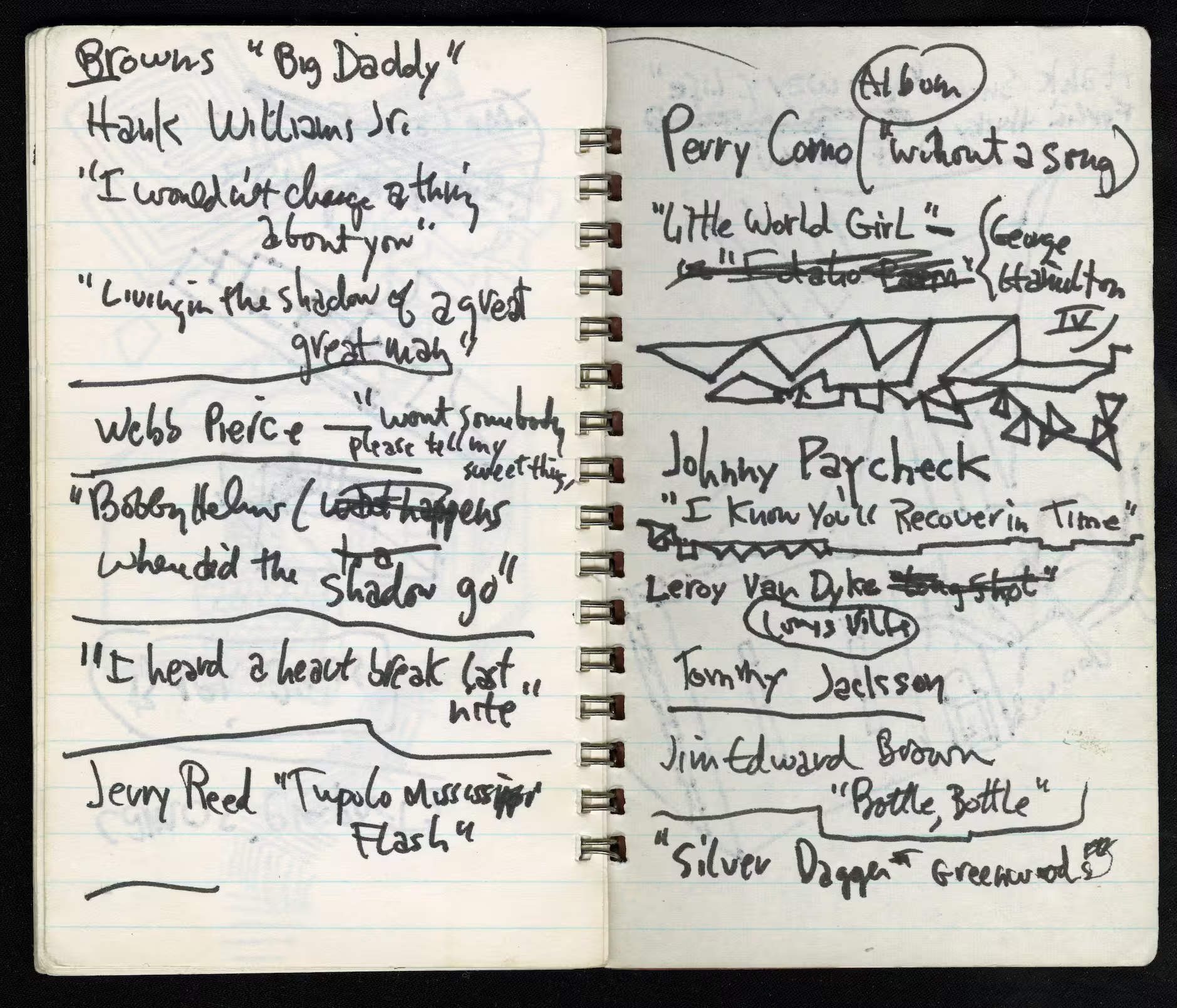
Dylan Notebook.
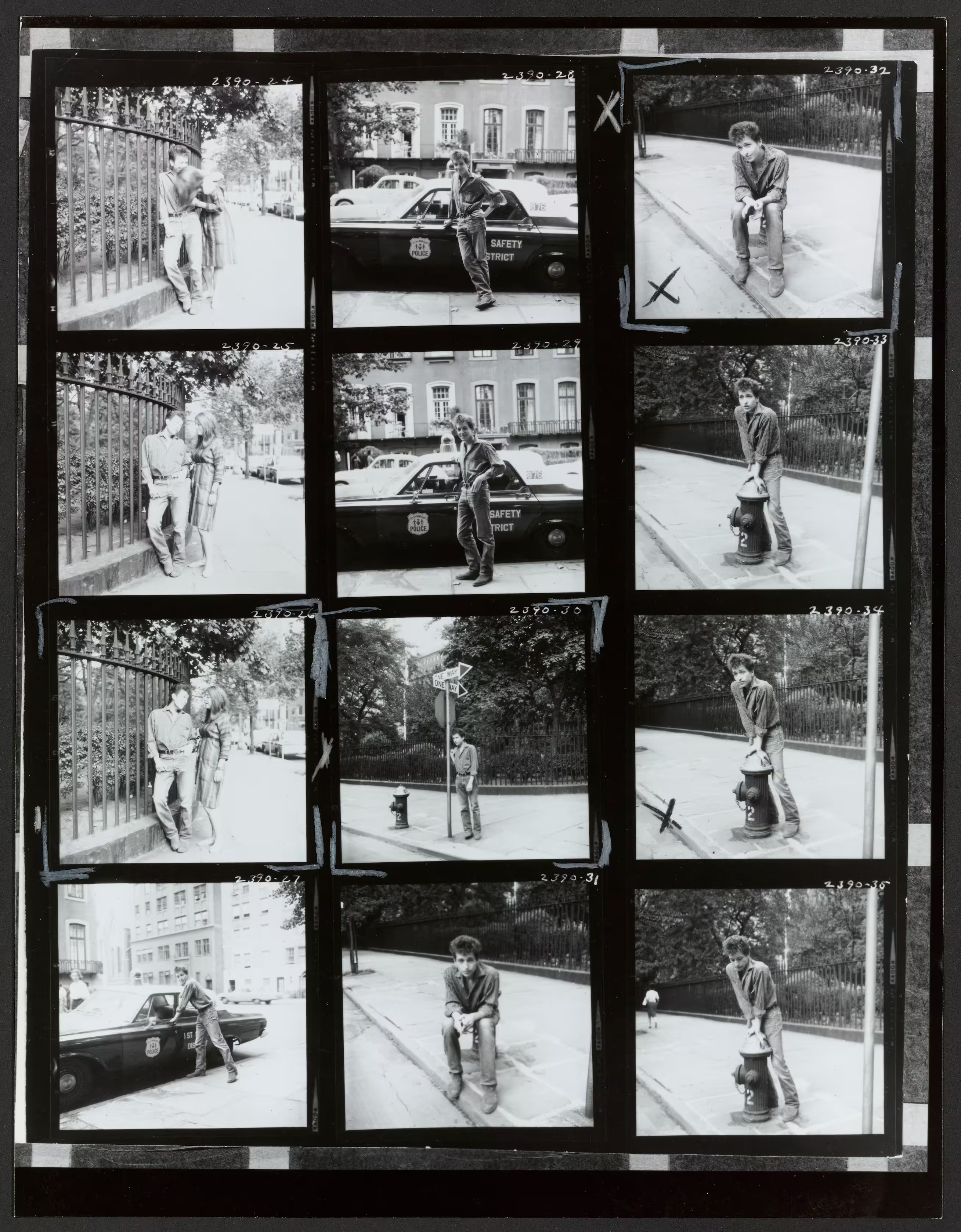
Ralph Baxter, 1963.
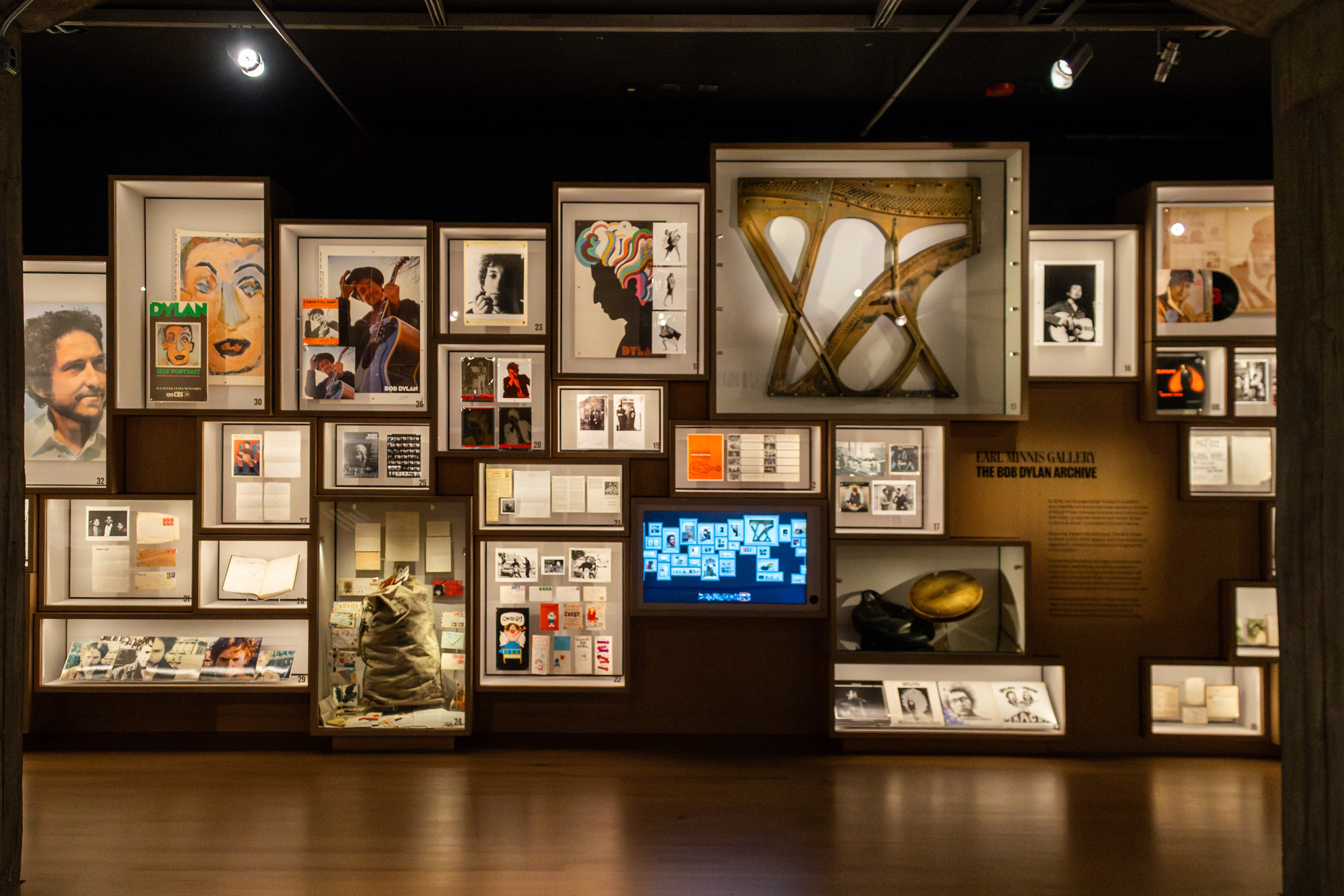
Saved and preserved over decades, the Bob Dylan Archive is the personal collection of the Nobel Prize–winning songwriter, documenting his career from the early 1960s through the present day.
Tactile, tangible and deeply intimate, the archive pulls back the curtain on Dylan’s creative process — revealing his indefatigable work ethic, his relentless commitment to craft and his inability to stay in the same place for very long.
Acquired by the George Kaiser Family Foundation in 2016, The Bob Dylan Archive® is Bob Dylan’s personal collection of materials saved over the course of his seven-decade-and-counting career. With more than 100,000 items, the archive contains thousands of manuscript drafts, hundreds of notebooks and notepads, tens of thousands of photographs, hundreds of hours of video and film footage, many hundreds of letters, postcards, telegrams and faxes, as well as countless hours of studio, rehearsal and live recordings.
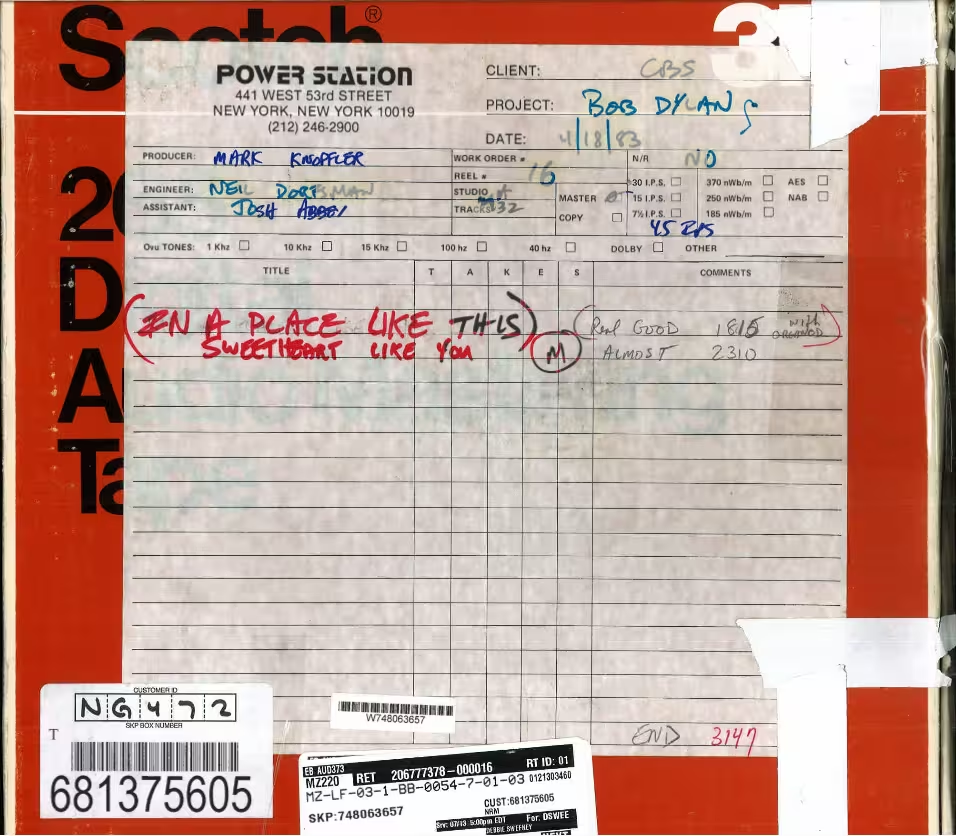
Sweetheart Like You tape box, Infidels sessions, 1983.
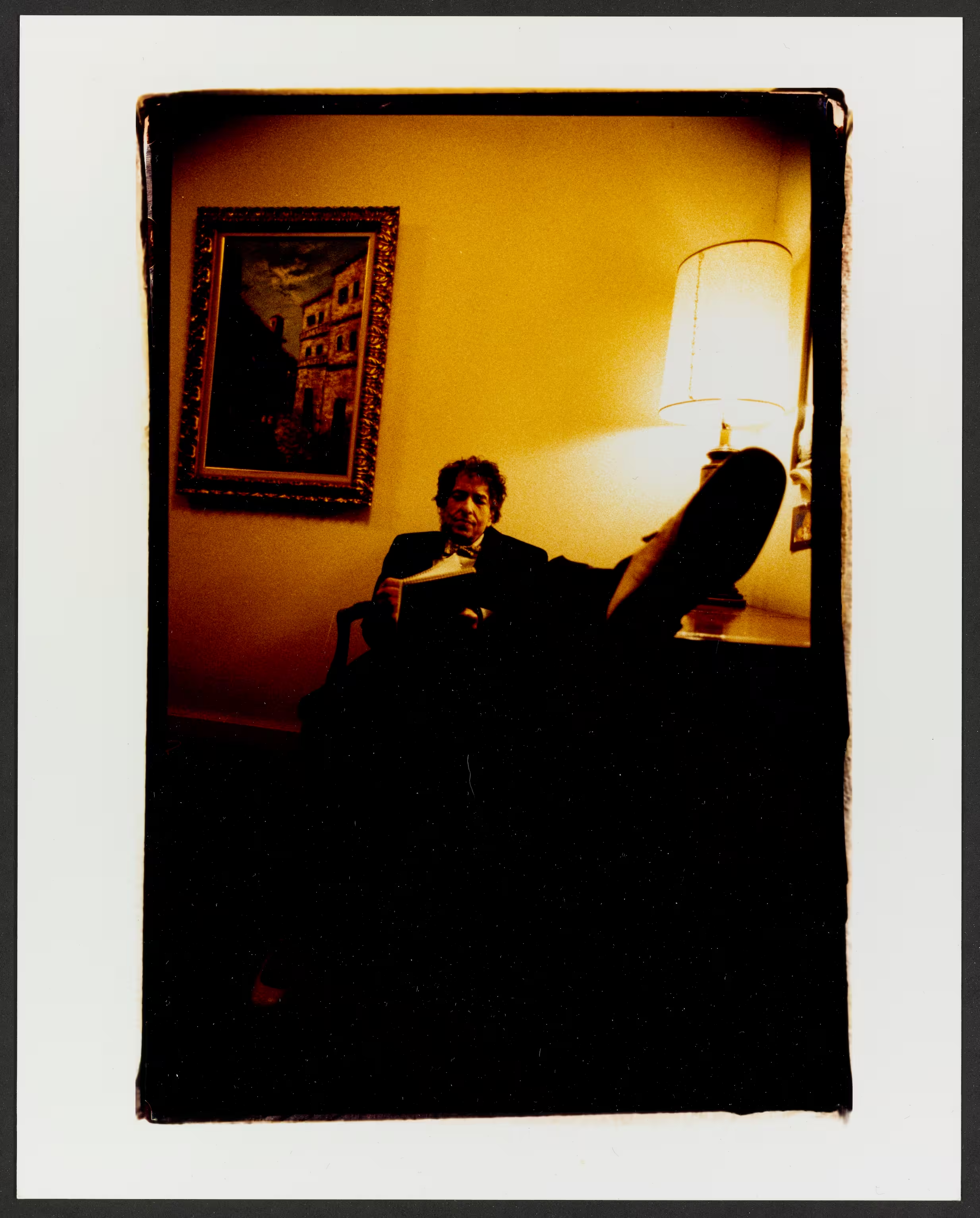
Danny Clinch, 1997.
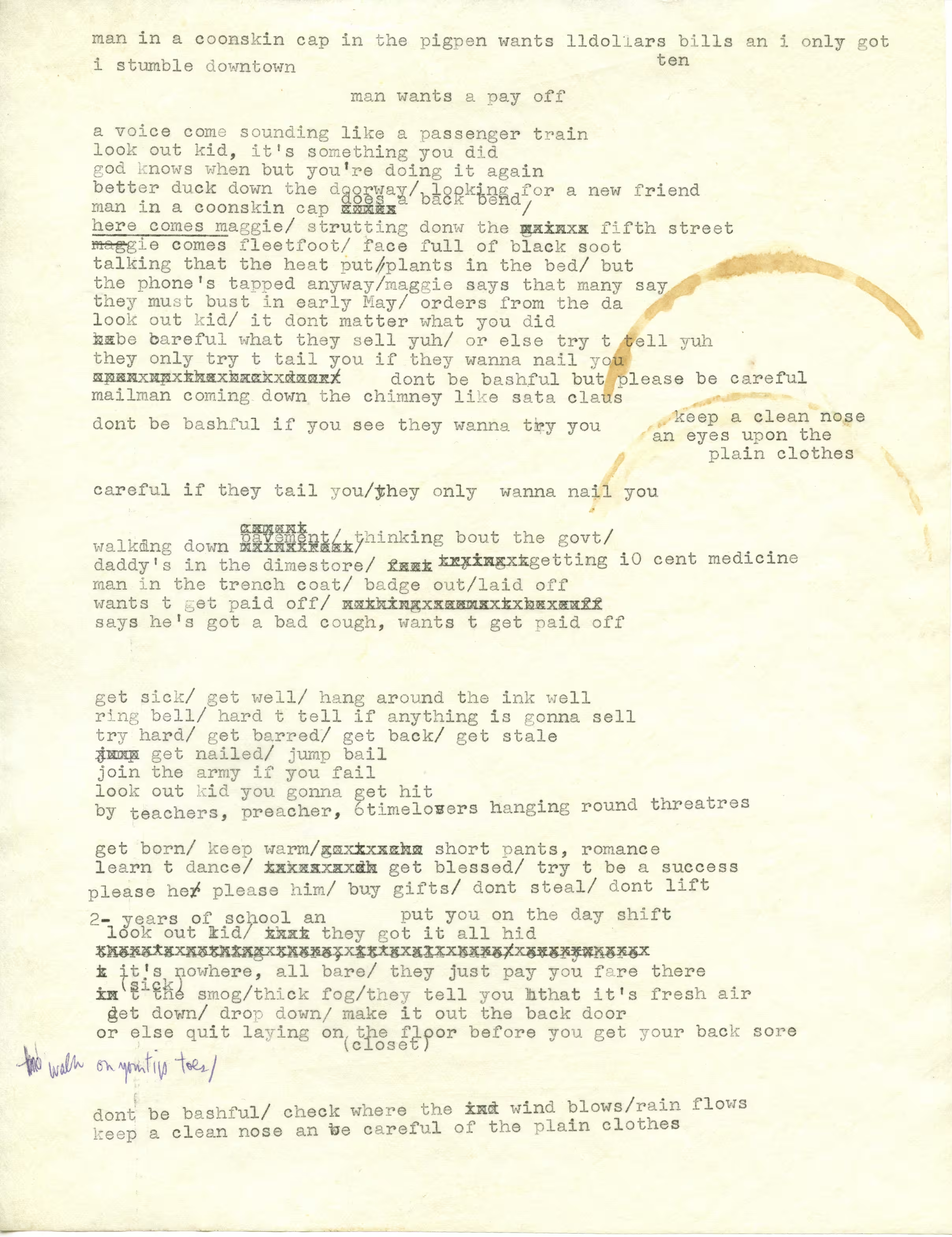
Subterranean Homesick Blues early typescript.
Housed in the Bob Dylan Center's Douglas and Anne Brinkley Reading Room, the archive is open to researchers by appointment only, and has supported scholarly work across multiple disciplines including popular music, film studies, American history, folklore, religious studies, sociology, political science and cultural studies.
The archive is arranged into twelve series. Here's what researchers will find across the collection.
Handwritten song lyrics beginning with Another Side of Bob Dylan (1964) and running through Tempest (2012). Most manuscripts are heavily revised, annotated, reconsidered, and sometimes abandoned. Includes both canonical works and lesser-known fragments that never made it to record.
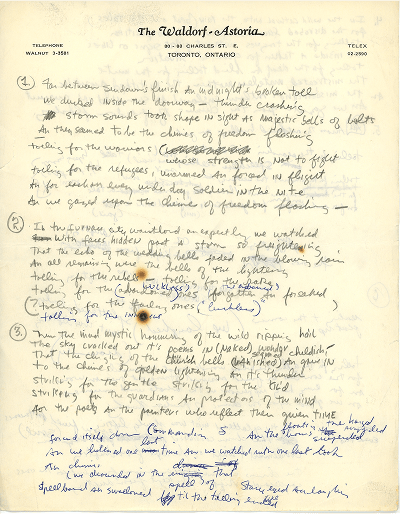
Dylan's handwritten lyrics for songs originally written by other artists, spanning the late 1960s through the early 1990s. Includes his handwritten versions of songs by Hank Williams, Woody Guthrie, and others. A revealing look at the music Dylan was absorbing across his career.
Essays, poems, liner notes, autobiographical passages, and philosophical musings organized by decade from the 1960s through the 1990s. Includes political writings, notes about Dylan's childhood and early musical heroes, and liner notes he contributed to recordings by other artists.
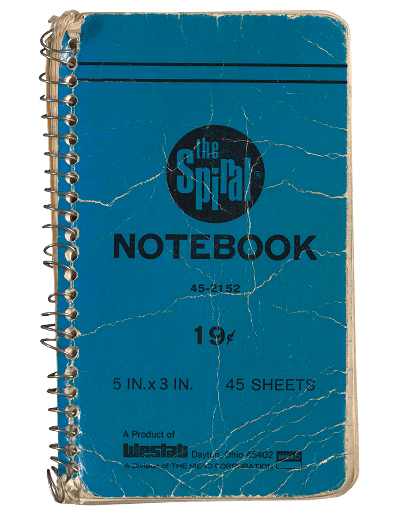
Pocket memo books, spiral notepads, and hardbound notebooks documenting Dylan's working process across three decades. Contents range from early sketches of songs that became Highway 61 Revisited to working drafts from Blood on the Tracks and Oh Mercy. Many are monogrammed hotel notepads.
Dylan's major creative work outside his studio albums. Includes multiple typescript drafts of Tarantula with handwritten corrections, his editing notes for Eat the Document, and liner notes he wrote for Peter, Paul and Mary, Dion, and Levon Helm, among others.
Business and legal records documenting Dylan's professional relationships across his career. Includes his original CBS recording contract from 1961, multiple publishing agreements with M. Witmark & Sons and Warner Bros. Music, and a 1969 telegram from Dennis Hopper and Peter Fonda regarding the use of "It's Alright Ma, I'm Only Bleeding" in Easy Rider.
Session reports, union contracts, and CBS Records tape data sheets documenting the recording of Dylan's albums from 1961 through 1976. Each report logs the date, songs recorded, musicians present, studio, engineer, and producer.
Official typescript copyright registrations of Dylan's songs spanning 1965 through 2009. Covers his entire recorded catalog and includes registrations for unreleased songs that never appeared on any album.
Promotional materials, publications, photographs, and artifacts organized by decade. Notable items include Dylan's leather wallet from 1966 containing Johnny Cash's contact information and business cards for Otis Redding, alongside a small notebook with early lyrics for "It Ain't Me Babe" and "My Back Pages."
Letters, postcards, telegrams, and faxes exchanged between Dylan and figures across music, literature, film, and public life, spanning the early 1960s through the 2000s. Correspondents include Allen Ginsberg, George Harrison, Johnny Cash, Joan Baez, Pete Seeger, and Bruce Springsteen, among many others.
Original sheet music for Dylan's songs arranged alphabetically, covering his catalog from "Abandoned Love" to "Yonder Comes Sin." Includes album tracks, B-sides, unreleased songs, and film compositions, with many entries containing multiple versions or copies.
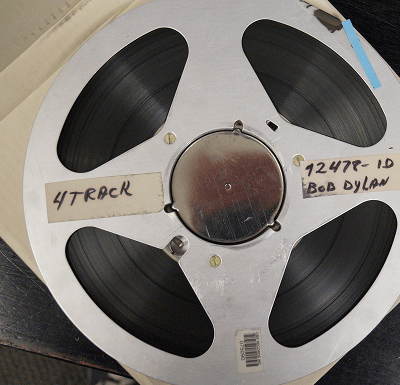
Master tapes of Dylan's entire recorded catalog from his 1962 debut through Together Through Life (2009), alongside singles and soundtracks. Film holdings include original materials from Don't Look Back (1967), Eat the Document (1971), and No Direction Home (2006), plus concert recordings spanning from early Minnesota tapes in 1958 through the 1992 30th Anniversary Concert.
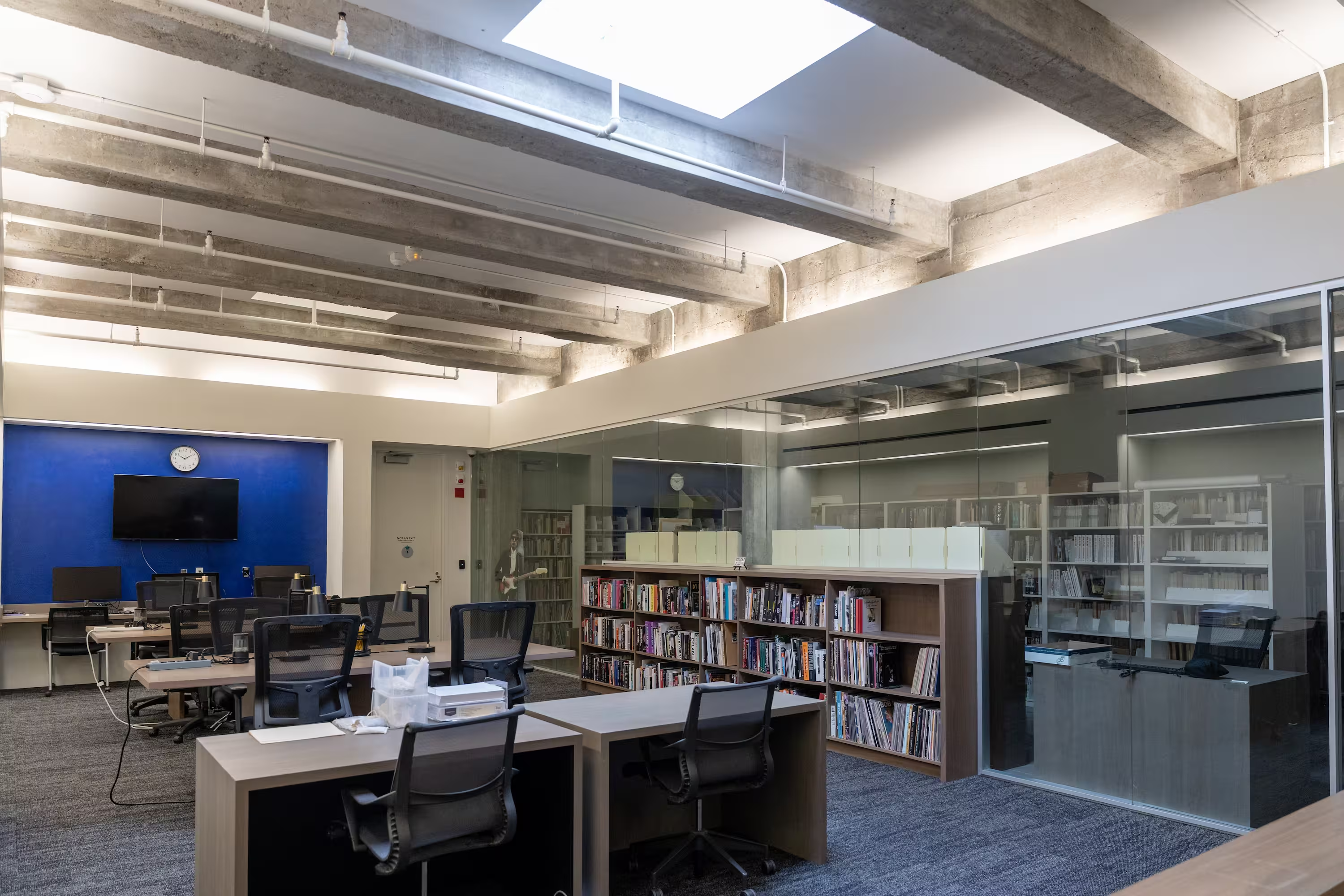
Research at the Bob Dylan Archive® takes place in the reading room at the Bob Dylan Center, by appointment only. The archive cannot accommodate unannounced researchers or walk-ins.
Monday – Friday, 9:30 a.m. – 4:30 p.m. The reading room is open to approved researchers on Mondays and Tuesdays even when the Woody Guthrie Center is closed to the public.
Archives need time to pull materials and there are limits on the number of people who can conduct research at one time. Please apply for access to the archives well in advance of your proposed research dates.
Please limit your request list to the most useful items for your research. You may need to make several return visits to examine materials. Consider the number of materials you plan to examine and leave extra time just in case.
The finding aids, detailed inventories of what's in the collection, are available here. Familiarizing yourself with the collection before you arrive will help you make the most of your time in the reading room.
Archives typically provide researchers with one box at a time from the list of requested materials. Within the box, you can use one folder at a time, replacing each before pulling the next. This practice helps keep the materials in order. Archives staff will also provide a placeholder to mark the folder location within a box.
Do not lean on archival materials, take notes on them, or hold them up. Keep materials flat on the table while in use. Although older materials are thought to be more fragile, newer materials also need to be handled with care for future use.
Pens are not permitted in the reading room. If an accidental mark is made, pencil can be erased. Ink cannot.
Personal items are not allowed in the research area. You will be asked to store your belongings in a storage locker or in an area away from the reading room. Researchers may use their own pencils and loose-leaf writing paper in the reading room, but other personal items must be stored in lockers.
This guideline is designed to help preserve the collections. Spills can irreparably damage documents or require costly repairs by a conservator. The presence of food may also attract insects or rodents that infest archival materials.
In most cases, clean hands free of lotions or perfumes are sufficient for handling materials. Gloves may be necessary for certain items such as photographs to protect materials from oils and residues on bare hands. The archives will provide gloves for handling these items.
Please silence phones and take calls outside of the reading room.
Archives are kept at cool temperatures to help ensure the longevity of materials and to protect fragile documents from mold and insects.
Due to rights and donor restrictions, laptops, cameras, scanners, and recording equipment are not allowed while conducting research in the reading room. While you cannot check out or borrow materials from archives, you can take notes for later reference. Paper (unlined), pencils, and magnifying glasses are made available in the reading room. Cameras and laptops are not allowed due to rights and donor restrictions.
The ASA archives includes both physical and digital collections. Digital collections can be viewed on the computers provided in the reading room.
Conducting research in the archives does not grant researchers permission to publish their findings. We do not hold copyrights to the materials in the collections, and researchers must secure any necessary rights, permissions, or licensing for the materials used or quoted in their work. Whenever possible, archives staff can provide publisher or other contact information for permissions.
Some materials are not available for use due to condition issues or rights and privacy restrictions. Unprocessed materials are generally not available for use, although exceptions may be made under special circumstances. Please consult with archives staff for more information.
Special note about the Woody Guthrie Archives: In compliance with donor stipulations, archives staff will need to photocopy any research notes compiled while conducting research in the Woody Guthrie collections.
Please site materials using the following format: Item title or description, Location (box, folder), Collection name (e.g., “Woody Guthrie Manuscripts Collection,” or “The Bob Dylan Archive”), courtesy of American Song Archives, Tulsa, OK
Before you apply, we recommend browsing the finding aids here to identify the specific materials relevant to your research. A focused request list makes for a stronger application and a more productive visit.
Complete the form below to request access to the Bob Dylan Archive®. Please apply at least one month before your expected visit. Archives staff will follow up after reviewing your materials.